

Future Readiness
Working with leadership teams and boards on the future their organisation is heading towards, and what to do about it now.
Future Readiness helps leadership teams see the changes ahead more clearly, including those they have not yet considered, from both an outside-in and an inside-out perspective. With both in view, they work through the uncertainties and the differences in how each of them reads those changes, and reach an agreed view of what they are preparing for and what they will do now.

Agreeing what the direction means in practice
Most leadership teams already have a vision, a mission and a set of values. Future Readiness works on what comes next: what they mean in practice for the organisation, area by area, given how the future could unfold. Each member of the team brings their own view of that future, shaped by their role and experience. The work starts by drawing out those views individually and setting them against external trends and signals, so that differences and gaps come to light early.
From there, the team can agree which uncertainties matter, what it is betting on, and what it would do if an uncertainty went one way or the other.
- Future: partly
- Ambition: clear and aligned
- Landscape: partly
- Assets: clear and aligned
- Offerings: needs work
- Go to Market: needs work
- Skills: partly
- Partners: needs work
- Positioning: partly
- Trend
- AI moves from pilots into everyday operations
- Trend
- Energy costs stay high and harder to predict
An uncertainty the team agreed matters
How quickly will customers and regulators accept decisions made by AI?
QuicklyAI-led service becomes the norm
SlowlyHuman review stays required
We created Future Readiness in response to four patterns we have seen often in many years of strategy work.
-
When today needs all the attention
Strategy work can feel like a luxury when the present business needs every hour. The work is shaped by what the first phase shows, so the team's time goes where it is needed.
-
When strategy sits with a few people
Strategy is often developed by a few, with everyone else updated at the next away day. Here each member of the leadership team gives their view and shapes the decisions.
-
When strategy stays apart from today
A good long-term strategy also guides the decisions being made now. The charter comes with an action plan, and with the near-term events and signals worth watching.
-
When strategy is done once
A strategy agreed a few years ago may no longer fit what has changed since. The Charter Refresh brings the team back to it at set points, and whenever something changes the picture.
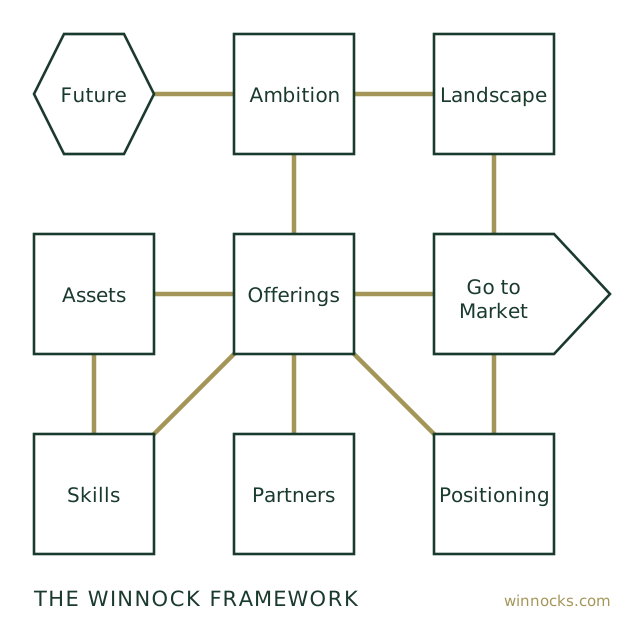
The Winnock Framework
The method behind Future Readiness: nine areas of readiness in three domains, strategy, delivery and capability. The work starts with the future the organisation is preparing for, at a future year agreed at the start: when the main trends are expected to have significantly changed the context it works in. The other areas are agreed against it. The framework originates in the Technology Leadership Framework, devised by Winnocks' founder as Chief Technology Officer at the Net Zero Technology Centre.
What each phase gives the team
Phase 1: Future Readiness Review
How your leadership team sees the future it is heading towards, set against an outside-in Trends Scan of the changes ahead.
- Questionnaire
- Trends Scan
- Results meeting
What the team takes away:
- A shared view of the future it is planning for. The team comes away with an agreed set of trends and uncertainties to plan around, where before each person held their own reading.
- A heatmap and agreed priorities. The heatmap shows how clear and aligned the team is on each of the nine areas, with an agreed order for what to work on next.
The Future Readiness Review can be commissioned on its own, with Phase 2 to follow then or later.
Phase 2: Decisions and agreement
Designed from what the review shows.
- Scenario workwhere needed
- Decision sessions
- Charter and action plan
What the team takes away:
- From scenario work, where needed: a decision made in advance on what it would do if a key uncertainty went one way or the other, and the signals that would show which way it is going, recorded in a Futures Map.
- From the decision sessions: decisions made together, area by area, so the whole team has shaped what it will act on.
- From the Strategy Charter and action plan: what the organisation will do and why, with who does what, by when, and what comes back to the leadership team, so the work moves straight into action.
A leadership team moving together in an agreed direction, with a plan to act on it
The outcome is a leadership team that agrees what it is preparing for, what it is betting on and why, and what each member does next, and that can adapt when the picture changes.
The Strategy Charter records, area by area, what the organisation has decided and why. The action plan alongside it sets out who does what, and by when; how each action is carried out stays with its owner. The charter also lists the signals and events worth watching.
Because it holds decisions and the reasoning behind them, the charter can be shared with your board, investors, partners and the wider organisation. When something changes, the connections between the nine areas show which other parts are affected, so the team revisits those parts without starting again.
Strategy Charter
What we will do, and why
Strategy
Future
Ambition
Landscape
Delivery
Positioning
Go to Market
Offerings
Capability
Skills
Assets
Partners
Action plan
The Charter Refresh
The first Charter Refresh, around six months after the charter is agreed, is included. The team answers the same questionnaire again, so the results show what has changed since the review, and checks progress on the action plan. Later refreshes are typically annual, or follow an event that changes the picture.
- Charter agreed
- First Charter Refresharound six months
- Later refreshesyearly, or when something changes
How quickly will customers and regulators accept decisions made by AI?
What the indicators show
- Guidance on automated decisions
- Published ↑
- Complaints about AI-led service
- Steady →
- Competitors offering AI-led service
- Two more ↑
Revisit: Offerings and Go to Market. The rest of the charter stands.
The Trends Scan
The Trends Scan is the outside-in part of the Future Readiness Review, and can also be commissioned on its own. It is a structured search for signals of change across themes agreed with you. The signals are organised into trends, and each trend is traced from global level to what it means for your organisation.
The output is a dated Trends Report: a page per theme with the key signals, the opportunities and risks, and indicators to watch; the main uncertainties, each with its two possible outcomes; and a watch list of emerging issues. The findings can be read in about twenty minutes, with the supporting evidence set out behind them.

AI in everyday operations
Signals
- Service teams in several sectors move routine customer queries to AI agents
- Suppliers start pricing contracts on outcomes delivered by AI, not hours
- New guidance on explaining automated decisions to customers
Trend
AI moves from pilots into everyday operations
For your organisation: lower cost to serve, and new questions about skills and accountability
Opportunity
Serve more clients with the same team
Risk
Competitors set a new price point first
Uncertainty
How quickly will customers and regulators accept decisions made by AI?
SlowlyQuickly
Indicators to watch
Regulatory guidance on automated decisions · complaints about AI-led service · supplier pricing models
Foresight, and both sides of strategy work
The approach comes from experience on both sides of strategy work: commissioning it inside an organisation, and delivering it as a consultant. Training in systemic team coaching shapes how the sessions run.
Winnocks' founder spent ten years leading technology innovation, strategic foresight and horizon scanning at the Net Zero Technology Centre, working across the drivers of change most organisations now need to watch: technology and AI, climate change and the energy transition, geopolitics, and shifts in society and work.
-
Commissioned
Strategy work seen from inside the organisation
-
Delivered
Strategy work delivered as a consultant
-
Coaching
Trained in systemic team coaching
-
Foresight
Led strategic foresight and horizon scanning across the key drivers of change
Leadership teams and boards
Leadership teams and boards who need to agree what their organisation is preparing for, what it is betting on and why, and turn it into a charter and an action plan the whole organisation can act on.
Let's talk
We start with a conversation, to understand where you're starting from and whether we can help.