The Winnock Framework
A structured method for clarity and alignment on what's changing — and a plan the whole organisation actually agrees on.

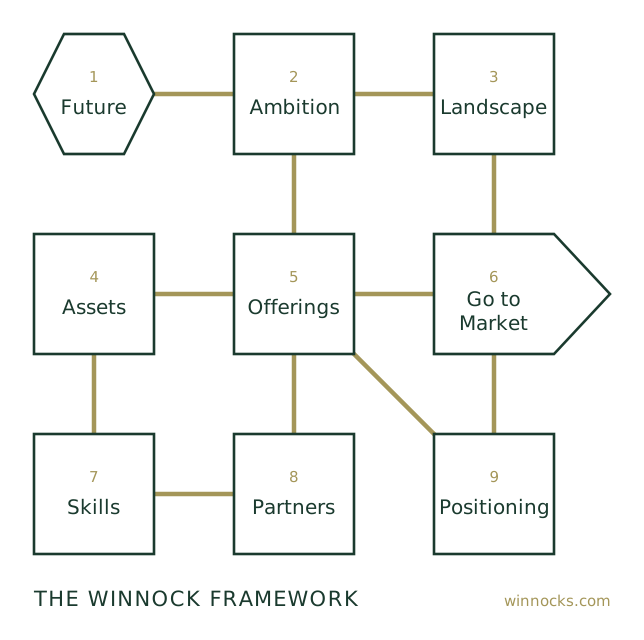
(Based on the NZTC Technology Leadership Framework.)
The value isn't just having a plan. It's having a plan the leadership team, the board, and management actually agree on and understand — so it becomes shared language across the organisation, not something handed down by an external consultant.
The problem
Most organisations, when asked, will say they have a strategy. What they usually have is a vision or mission statement — a direction, not an operationalised plan. Once a leadership team has agreed on a future scenario worth preparing for (whether through working with us on Futuring, or one they already hold), the next question is what the organisation actually needs to do, know, and have to be ready for it — or to help make it happen, if it's a future they want to bring about.
The method
The Winnock Framework is our structured methodology for turning a future scenario into an operationalised plan across three domains: strategy, delivery, and capability. It produces an actionable executive plan, not a massive strategy deck — covering what needs to happen, and why, area by area.
Some areas take fifteen minutes because the team is already aligned. Others take an hour or more because they're not. Progress is tested, not assumed. Each working session closes by checking whether what's just been agreed actually holds, before moving on to the next area.
Where it comes from
The Winnock Framework's nine-area structure originates in the Technology Leadership Framework, which Winnocks' founder devised as Chief Technology Officer at the Net Zero Technology Centre to link technology foresight to strategy, delivery and capability.
The deliverable
A Readiness Plan — the organisation's own plan, covering strategy, delivery, and capability, for the future they've agreed to prepare for.
Because the nine areas are explicitly connected, a change in one identifies what else needs re-checking — the affected areas and their neighbours, not everything. You revisit the affected part rather than repeating the exercise.
It measures the input, not just the output. Most change programmes are judged by results — a KPI hit, a plan delivered. This measures something earlier: whether the leadership team is genuinely willing to align, not just present in the room. Get that right, and the results tend to follow; skip it, and the same document gets read, half-agreed with, and quietly reinterpreted by everyone differently.
"We had so many dials on the dashboard, we couldn't see the road anymore."
— A CEO
Who this is for: Leadership teams and boards who already have a scenario to prepare for and need it translated into a plan they can act on, adapt, and use as common language across the organisation.
Keeping it current
A Readiness Checkpoint revisits the plan — the same questionnaire, a shorter engagement — annually, or whenever something significant changes. Because the nine areas are connected, a change in one identifies what else needs re-checking, so the work is a revision rather than a repeat.
Where to start
A no-obligation 30-minute conversation to understand where you're starting from.
Book a Scoping Conversation →