

Strategy Coaching
Working with leadership teams and boards, in organisations of any size or sector, on what the key drivers of change mean for them, and what to do about it, now and for the future.
Key drivers of change, such as the energy transition, climate change, AI, shifting geopolitics and the future of work, affect each organisation differently. Strategy coaching helps your leadership team agree, area by area, what they mean for yours and what it will do, recorded in a Strategy Charter.

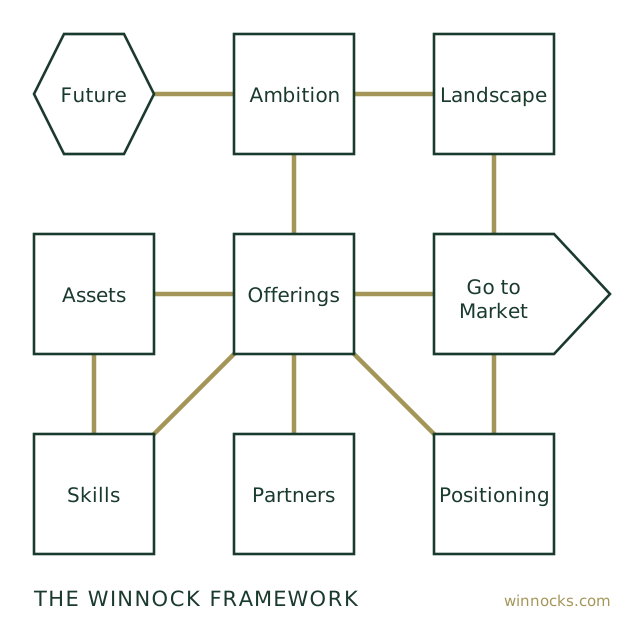
The Winnock Framework
A structured method for clarity and alignment on what's changing: nine areas of readiness, in three domains — strategy, delivery and capability. It originates in the Technology Leadership Framework, devised by Winnocks' founder as Chief Technology Officer at the Net Zero Technology Centre.
Agreeing what the direction means in practice
Leadership teams can agree quite easily on a vision, a mission and a set of values. Between those and the detailed goals and KPIs lies harder work: agreeing, area by area, what is needed in practice and why. False alignment hides there: agreement on the vision feels like agreement on everything else, and the detailed plans see the trees rather than the forest. Each person then plans from their own reading, and the differences tend to appear later, when decisions are being carried out.
The areas also depend on each other: an ambition needs offerings that can deliver it, offerings need the skills to support them, and how you position the organisation needs to fit the market segments you target.
Most change programmes are judged by their results: a target hit, a plan delivered. The Clarity and Alignment Assessment measures something earlier: how clear the leadership team is on each area, and how far its members agree. It shows where the gaps are before the work starts.
"We had so many dials on the dashboard, we couldn't see the road anymore."
- Future: partly
- Ambition: clear and aligned
- Landscape: partly
- Assets: clear and aligned
- Offerings: needs work
- Go to Market: needs work
- Skills: partly
- Partners: needs work
- Positioning: partly
Four steps to clarity and alignment
Phase 1: Insight and priorities
-
Step 1
Preparing the ground
We agree how far ahead the work looks, based on when you expect the key trends affecting your organisation to have significantly changed the context it operates in. We also agree who takes part and whether to include Futuring, and we meet the team to explain the approach.
-
Step 2
Mapping strengths and priorities
Each member of the leadership team answers the Winnock Readiness Questionnaire, covering all nine areas. We then meet the team to review the results together and agree the priorities: a prioritisation heatmap shows where alignment is strong and where it may need checking, with a recommended sequence for the work.
Phase 1 can be commissioned on its own, with Phase 2 to follow later if wanted.
Phase 2: Decisions and alignment
-
Step 3
Working sessions
Facilitated sessions on strategy, delivery and capability, where the decisions are made, area by area. Each session closes by checking that what has been agreed still holds once the whole domain is visible. The sessions can also run as a single away day.
-
Step 4
The Strategy Charter
The charter takes shape in the working sessions, and we turn it into a document. In a review session, you and your team refine it until it reads as fully yours, and agree it.
An aligned leadership team, and a Strategy Charter it owns
The outcome is alignment: a leadership team that has worked through each area together and agrees what the organisation is doing and why. The Strategy Charter records that agreement in a practical and actionable document that sets out, area by area, what the organisation has decided and why. How, who and when stay with the people responsible for delivering it.
Because it holds decisions and the reasoning behind them, it can be shared easily with your team, board, investors or partners.
When something changes, inside the organisation or outside it, the connections between the nine areas show which other parts are affected. The team revisits those parts, without starting again or reviewing the whole charter. Keeping the charter current in this way is what keeps the organisation ready as things change.
Strategy Charter
What we will do, and why
Strategy
Ambition
Landscape
Future
Delivery
Positioning
Go to Market
Offerings
Capability
Skills
Assets
Partners
Futuring
The first of the nine areas is the future the organisation is preparing for. Many leadership teams bring their own view to the first working session. Where that view does not yet exist, or each leader holds a different version of it, the Futuring deep dive builds one.
We do the preparation: research into the trends and drivers relevant to your situation, looking ahead to the horizon agreed at the start. The leadership team, with external stakeholders where useful, develops scenarios and ranks them by probability and impact.
The output is a Futures Map: your scenarios, each with the signals worth monitoring.

Both sides of strategy work
The approach comes from experience on both sides of strategy work: commissioning it inside an organisation, and delivering it as a consultant. Training in systemic team coaching shapes how the sessions run.
Winnocks' founder spent ten years leading technology innovation, strategic foresight and horizon scanning at the Net Zero Technology Centre, working across the drivers of change most organisations now need to watch: technology and AI, climate change and the energy transition, geopolitics, and shifts in society and work.
-
Commissioned
Strategy work seen from inside the organisation
-
Delivered
Strategy work delivered as a consultant
-
Coaching
Trained in systemic team coaching
-
Foresight
Led strategic foresight and horizon scanning across the key drivers of change
The Charter Refresh
A shorter engagement that keeps the charter current, starting from a follow-up questionnaire. The first Charter Refresh, around six months in, is part of the engagement. Later ones are typically annual, or whenever something material changes in any area.
- Charter agreed
- First Charter Refresharound six months
- Later refreshesyearly, or when something changes
Leadership teams and boards
Leadership teams and boards, in organisations of any size or sector, who need to agree what the organisation is doing and why, for now and for the future, and turn it into a charter the whole organisation can act on.
Every engagement starts with a conversation
Around 30 minutes, to understand where you're starting from and whether we can help.