Ask a leadership team whether they're aligned on the plan and they'll say yes. Ask them to describe the plan separately and you get different answers.
Not wildly different. That would be easier, because it would be visible. The differences are the kind that survive a hundred meetings without ever being stated: one person believes the priority is expanding into an adjacent sector, another believes it is deepening the core one; one has understood a capability decision as a commitment to recruit, another as a commitment to partner. Each has been in every conversation. Each is confident there is agreement. The organisation below them receives a slightly different instruction from each, and spends a great deal of energy reconciling them.
I have spent three decades in and around that problem — twenty years in consulting, then ten as chief technology officer of a national technology centre. Long enough to have been brought in to fix it from outside, and to have lived with it from inside. What I have come to think is that we misdiagnose it. We treat it as a communication failure, which makes it somebody's job to communicate better. It is more often a structural one: the plan was never made in a form specific enough for the team to discover they disagreed.
The vision problem
Ask most organisations whether they have a strategy and they will say yes. Ask to see it and you are frequently shown a vision statement. To be the trusted partner of choice, delivering innovative and sustainable solutions for our customers and stakeholders.
Every word is agreeable. That is the difficulty. A statement that nobody can disagree with cannot align anybody, because alignment requires something to align to. A vision rules nothing out, so any subsequent decision can be justified by reference to it, and two executives pulling in opposite directions can each cite the same sentence in support.
This is why alignment work so often fails when it is treated as a communications exercise appended to the end of a planning process. There is nothing wrong with the cascade, the town hall, or the one-page summary. They are simply being asked to distribute a decision that was never actually made at the level of specificity required to be shared.
The test I now use is blunt: could a competitor sign this? If a rival organisation could adopt your strategy statement without changing a word, it is not a strategy. It is a description of wanting to do well.
The second test follows: what does this rule out? If the answer is nothing, the team has not yet decided.
Where alignment actually comes from
The conventional sequence is: analyse, decide, then align. Consultancies are structured around it, and so are most internal planning cycles. Analysis produces options, leadership selects, and then the organisation is brought along.
The difficulty is that the third step is doing work the first two made impossible. If the team did not build the decision, they hold a version of it — their own reconstruction, assembled from what they heard and what they already believed. Reconstructions differ. And because the plan arrived rather than emerged, nobody in the room has been forced to state a position precisely enough to notice they hold a different one from the person beside them.
There is a further problem, which is ownership. A plan produced by an external party and handed over cannot be modified by the people who hold it, because they do not know which parts are load-bearing. When conditions change — and they change constantly now — the organisation's options are to carry on with a plan that no longer fits, or to commission the whole exercise again. Neither is good, and the second is expensive enough that most organisations choose the first for longer than they should.
Alignment, on this reading, is not a phase. It is a property of how the decision was made. If the leadership team argued it out, in a structure that forced each position to be specific, the alignment is already there when the plan is finished. It does not need to be added.
That is a claim about method rather than about better intentions, and it is the claim the rest of this piece is about.
Three things such a method would have to do
If alignment is a property of how a decision was made, then the question becomes what a decision-making method would need in order to produce it. Three requirements, and they are more demanding together than any of them is alone.
The team has to build it, not receive it. This is the co-creation requirement, and it is not about consultation or buy-in. A team that has been consulted still holds a reconstruction. A team that has argued its way to a decision holds the decision, including the parts it lost — which matters more than it sounds, because knowing what was considered and rejected is most of what allows someone to apply a decision to a situation nobody anticipated. The practical consequence is that whoever runs the process cannot also supply the content. They can bring structure, questions, and the discipline to keep going when the room would rather move on. The answers have to come from the people who will live with them.
It has to work at the right altitude. This is the requirement most often missed, and I think it explains why so much alignment work fails despite genuine effort.
Most organisations hold three documents. A vision statement, which sits too high — nobody can disagree with it, so nobody can align to it. A strategy document, which is where the analysis lives: addressable markets, quarterly targets, balanced scorecards, a hundred pages of it. And functional plans, which are where the work actually gets scheduled.
The strategy document is usually circulated to the executives who write those functional plans, so the failure is not one of distribution. It is that they receive it rather than co-author it, which means each holds a reconstruction rather than the decision. And it stops at that layer. The people who report to those executives see the functional plan and never the reasoning behind it — either because the strategy document is not shared, or because when it is, nobody reads it. It is too long, too abstract, and visibly written for somebody else. Above my pay grade.
What is missing is a level between the aspiration and the analysis, and it is rarely written down at all. Which markets. Which offerings. Which skills the organisation will need access to. Which partners. What the market has to believe about us. These are decisions rather than aspirations, specific enough that two executives holding different views will find out, and general enough to be handed to a team without redaction. A document at that level can be built with the functional leads in the room, passed to their people unchanged, and used to collect the input that shapes the next revision. One document, one language, one level of complexity, all the way down.
It has to be revisable in parts. Any plan built for a future beyond the next budget cycle will meet conditions it did not anticipate. If revising it means repeating the whole exercise, organisations stop revising — the cost is too high, so they carry on with a plan that has quietly stopped fitting. For revision to be bounded, the relationships between decisions have to be explicit: change this, and these are the things that now need re-checking. Which in turn means the plan cannot be a narrative. It has to have a structure whose parts are visibly related to one another.
The framework below is what I arrived at trying to meet those three requirements at once. The nine areas are the altitude; the way they are worked is the co-creation; and the connections between them are what make revision bounded.
One clarification before the framework itself. None of this is a replacement for the strategy document, which does a different job at a different horizon — this year, the next four quarters. What is described here operates a horizon further out, on the question of what the organisation needs to be ready for and what that requires of it. Most organisations have three documents for the near term and nothing at all for that one.
Nine areas of readiness
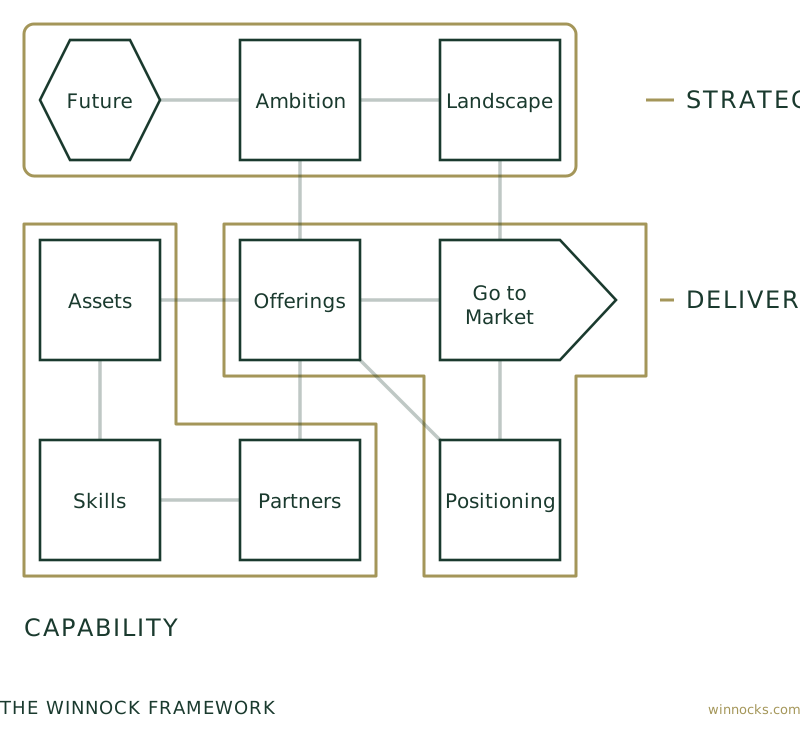
The Winnock Framework covers nine areas of readiness, arranged in three domains.
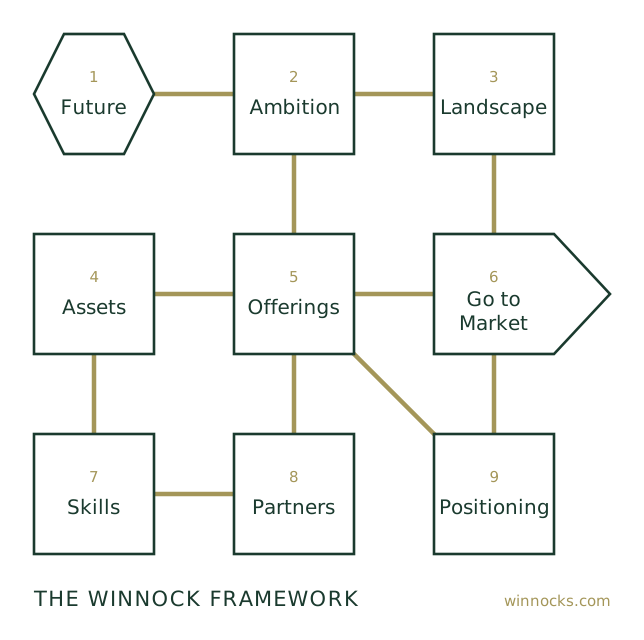
Strategy is the top row. Future holds the view of how the operating environment could change beyond the normal planning cycle — the scenario the organisation is preparing for. Landscape holds who else is active in that space, including organisations not in the market today that could plausibly enter it. Ambition sits between them, and is the decision: given that future and that landscape, what does this organisation intend to become, and whose needs is it here to serve?
Delivery and Capability are how that ambition is realised.
Delivery covers what the organisation offers, which markets and clients it serves, and what those markets need to believe about it. Offerings, Go to Market, Positioning.
Capability covers what it needs in order to do that. Assets — what must be owned or reached, including the question of what the organisation knows that is genuinely distinctive now that so much knowledge is a subscription away. Skills — what the organisation will need access to, which is a different question from what it should employ. Partners — who supplies the capability and the capacity it will not build itself.
Three observations about the shape, because the shape is doing more work than a list of nine topics would.
Offerings is the busiest area in the grid, connecting the strategy row with the two interlocking L-shaped domains of Delivery and Capability, and it is the point through which most changes propagate.
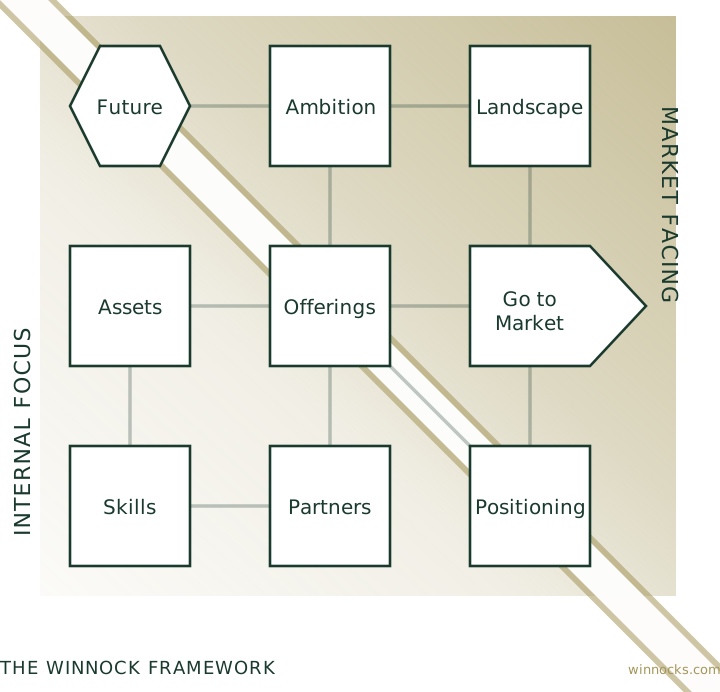
A second reading runs diagonally. The lower-left of the grid is internally focused — what we have and can draw on. The upper-right is market facing — the world outside and our choices about our place in it. Three areas sit on the diagonal and are genuinely both: Future is the outside world as this team reads it, Offerings is where capability meets market, and Positioning is our own decision about how we are seen.
And the areas are connected — specifically, not uniformly. Eleven connections join particular pairs, and their function is not sequence. They do not say that one thing must happen before another; skills and assets for a new offering are needed at roughly the same time, not in a queue. What they say is that certain positions must be consistent with one another. If the team commits to an offering, that commitment implies things about the capability required to deliver it and the market that must believe in it. The connections are where inconsistency shows up.
Working the framework is iterative rather than linear, and the loops are where most of the useful argument happens.
What the structure does that a list does not
If the nine areas were simply a checklist, the framework would be a competent agenda and nothing more. Two things follow from the connections that do not follow from a list.
Inconsistency becomes visible rather than inferable. A leadership team can hold an ambitious offering set and a modest capability plan indefinitely, because the two live in different documents owned by different people. Put them in a connected structure and the mismatch is not a matter of judgement — it is a line on a diagram with nothing credible at one end of it. In practice this is the moment teams find most uncomfortable and most useful.
Revision becomes bounded. When something changes — a competitor moves, a technology arrives early, a market closes — the connections identify what else needs re-checking. Not everything. The affected areas and their neighbours. This is what makes a plan usable in conditions that will not hold still, and it is the practical answer to the organisation that has stopped updating its strategy because updating it costs too much.
I should be precise about the scope of that second claim. A change to the Future is the largest revision the framework absorbs, because the decision in Ambition depends on it and everything else depends on that. It is a bounded revision rather than a fresh start — but it is not a light touch, and I would not want to suggest otherwise.
What the Readiness Plan holds, and what it deliberately does not
The output is a short executive document: for each area, what the organisation has decided and why. Which markets. Which offerings. Which skills. Which partners. What the market needs to believe.
It stops there. It does not contain how, who, or when. Those belong to the people who own the work — the plan agrees what the market must believe, and the marketing function builds the campaign from it; it agrees which offerings, and product development builds them. What they build from is a decision their own leadership has argued out and agreed — frequently with them in the room — rather than a vision statement they have to interpret.
It is also not a timeline, which surprises teams who expect one. The connections establish consistency, not sequence. What replaces a date is a set of signals: the conditions that would indicate the anticipated future is drawing closer, or receding. Acting too early on a scenario that has not moved wastes resource. Acting too late loses the opportunity, or the ability to adapt at all. The plan holds decisions that are ready to act on; monitoring indicates when the moment has arrived.
I would resist making those signals deterministic. Reality is more complicated than when X, do Y, and a plan that promises automatic responses promises more than it can deliver. They are triggers for consideration, not for action. The judgement stays with the leadership team — which is the point of their having built the plan rather than received it.
There is a practical consequence of what the plan excludes that took me some time to notice. Because it holds decisions and reasoning rather than margins, volumes, targets and KPIs, it can circulate. A conventional strategy document mixes the two and therefore cannot be shared beyond a small group. This one can go to management, to a board, to investors, to partners. That is what allows it to become common language across an organisation rather than a document a handful of people have read — and common language is what alignment actually looks like when it is working.
On horizons, and on who this is for
The framework operates at the middle of three horizons: running the business well today, getting ready for what is changing, and the long-range view of what could transform the context entirely. It is the second of these — the work of preparation, which sits between the other two and is the one most often skipped, because the first is urgent and the third is interesting while the second is merely important.
The scenario it works from has to come from somewhere. Some organisations already hold one. Others build it through a separate foresight process — at Winnocks we call that Futuring — and others adopt one from a parent company, a sector body, or published research. All three are workable. The one that reliably requires the most care is the third, because an adopted scenario has usually never been argued about, and a team can believe it shares a view it has never actually tested.
The nine-area structure originates in the Technology Leadership Framework, which I devised as chief technology officer at the Net Zero Technology Centre to link technology foresight to strategy, delivery and capability. What is described here has changed considerably since, and it is no longer specific to technology.
The areas themselves are deliberately general. What differs between a two-hundred-person supply chain business, a scale-up with a board and investors to keep aligned, and a public body deciding where to invest is not which questions matter — it is the content that fills each area, the depth any one of them needs, and how much of the work the organisation can already do for itself.
The argument
Most strategy work produces a document and then attempts to distribute agreement about it. The distribution is treated as a change-management problem, which locates the difficulty in communication, in the organisation's receptiveness, in the quality of the cascade. I think the difficulty is usually earlier than that: the decision was never made specifically enough to be agreed on, and a plan the leadership team cannot individually describe was not shared to begin with — it was announced.
The alternative is to treat alignment as the product rather than the follow-on. That means the leadership team builds the plan, in a structure that forces each position to be specific enough to be disagreed with, with the connections between decisions visible so inconsistency surfaces while it can still be resolved. It is slower in the room and considerably faster afterwards, because the argument happens once, among the people who have to live with the outcome, rather than repeatedly and indirectly for the following two years.
Whether nine areas is the right number, or these nine the right ones, is a reasonable question and I hold it loosely. What I hold less loosely is the underlying claim: that a plan the leadership team argued its way into is a different object from one they were given, and that the difference shows up not in the document but in what happens in the eighteen months afterwards, when conditions change and somebody has to decide what that means.